



Floor Plans I Pricing & Cost I Design I Construction I Builders I Financing I FAQs I Modular Articles
|
|
|
|
|
|


Where Can Spray Foam Insulation Be Installed in a Modular Home?
The purpose of using spray foam insulation is have a more comfortable home that cost less to heat and cool. In addition spray foam stops air movement and moisture movement in modular homes.
Modular Home Exterior Walls
Installing spray foam insulation in the side walls of a modular home will provide a higher R-Value in side walls. Either open or closed cell spray foam can be installed in the side walls of a modular home. Closed cell foam installed in the side walls of a modular home is more popular due to the higher R-Value of seven per inch over open cell foams with R-Values ranging between 3.5 to to 5 per inch. Another benefit to closed cell foams is their high tensile strength. Closed cell foams stiffen the modules which can help reduce drywall cracking due to delivery and setting of the modular homes.
Closed Cell Spray Foam / Flash and Batt - Most factories offer a flash and batt system to insulate their modular home exterior walls. This system entails spraying a minimum of 1.5 inches of closed cell foam to achieve tensile strength, a moisture barrier and an R-Value of 10 with the closed cell foam. After the closed cell foam has been installed in modular home walls, un-faced fiberglass batts are installed to fill the void and add an R-Value of 14 to the cavity. The total R-Value to the wall cavity is close to an R-24.
Full Cavity Spray Foam - If you want to have a full cavity of spray foam insulation installed in exterior walls, I would recommend using an open cell spray foam. The cost of open cell is less than closed cell and offer the same benefits of closed cell foams in wall cavities. There are companies in the market who down grade open cell foam products largely because they are not able to offer them.
Open Cell Spray Foam R-Value - The R-Value for open cell foam range between 3.5 and five per inch. I would recommend installing an open cell spray foam with an R-Value of four or better per inch. This would give you a minimum R-Value of 22 for your modular home side walls cavities.
Framing Note: If energy efficiency is important to you, consider having your modular home 2x6 exterior walls framed 24" on center. Walls in the past were framed with 2x4 and required to be spaced 16" on center. Twenty four inch on center framing will minimize thermal bridging and cost less up front. If you want 16 inch on center walls to hang pictures and stuff, consider having the modular home factory install backer boards to the drywall and studs for a sturdy platform to hang stuff from the walls.
Modular Homes Perimeter Beams and Band Joists
"Stick" builders call them band joists and modular home factories call them perimeter beams. Each module on a modular home has two perimeter beams. The floor has a perimeter beam and the ceiling has a perimeter beam. A two story modular home has four perimeter beams. A ranch or cape cod only has two - the floor and the ceiling.
Two Story Perimeter Beams - Between the Floors
The perimeter beam between the first and second floor of a two story modular home is an area that should be air sealed and insulated with spray foam insulation. This area is notoriously both leaky and poorly insulated. If this area is not air sealed and insulated, the floors on the second story of the home will be cold and uncomfortable. In addition if there are excessive air leakage in this space between the first and second floor of a modular home, pipes could potentially freeze. I would recommend having three inches of closed spray foam insulation installed on the perimeter beam of the first floor ceiling and on the floor system of the second floor. After the home is set on the foundation, the holes drilled floors perimeter beam for the pick points can be filled with a one part spray foam.
Factory Built Modular Home Garage Ceilings
Modular homes where the garage is tucked under the second floor is problematic space to air seal and insulate. The garage space is an unconditioned space usually below bedrooms. Most climate zones require an R-30 in this space. In addition to protecting the occupants from heat loss, Garage spaces usually have a number of items which emit VOCs such as car exhaust, gasoline, paint and pesticides. By using spray foam insulation on the underside of garage ceiling, the floors above will be warm and the air flows will be stopped making the home comfortable and safe. The same Flash and batt system used with closed cell spray foam can be used in a modular home garage ceiling.
Modular Home, Knee Walls and Sloped Walls
Cape Cod modular homes are notoriously difficult to insulate on the second floor. Most factories install fiberglass insulation in the first floor ceiling cavity with an under R-Value of 30. If the modular home buyer is going to finish this space off in the near future, the insulation should be removed as per best practices and supported by building science due to potential moisture related issues. If a modular home factory is going to build the second floor of a cape cod as a wedge box, closed cell spray foam is an excellent option for the factory and a benefit to the home buyer. In addition to spraying the underside of the roof system with closed cell foam, the gable walls and dormers should be insulated with spray foam insulation at the same time.
Modular Homes with Flat Roofs
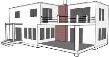
The more custom modular homes become, the more difficult some of the areas will be to insulate and air seal. Closed cell spray foam insulation is the perfect choice for insulating "flat" roofs. By spraying the underside of the roof, the area will be sealed and insulated right. In this area, I would recommend using two inches of closed cell and six inches of open cell spray foam with an R-Value of 38.
Floor Plans I Pricing & Cost I Design I Construction I Builders I Financing I FAQs I Modular Articles I Privacy Statement